


Most who are familiar with the Scout Rifle know it was conceptualized by Jeff Cooper, who was in search of the ideal general purpose rifle. But Cooper’s inspiration goes deeper than that. Integral to his foundational concept are some men who I feel helped mold Cooper and his Scout Rifle idea. This article—the second chapter of my book, The Scout Rifle Study [with comments] —is about those men.


In 1976 [Jeff] Cooper relocated to Paulden, Arizona and started the American Pistol Institute so shooters who wanted to learn under his tutelage could come to him. He established his home on what would be called Gunsite Ranch. Now, with a suitable range essentially in his backyard, Cooper could begin to further develop the ideal carbine concept he originated 10 years prior.
It was the perfect storm for the evolution of what would become the Scout Rifle. Cooper had time, he had a range, and he soon had a gunsmith on staff. In 1981 Cooper wrote, “We are continuing our experiments with Scout rifles. Such instruments are short, handy, 308, bolt-action rifles, generally fitted with plastic stocks and featuring strong, low-power telescopes mounted well forward—total weight not to exceed seven and a half pounds… Many feel that if a job cannot be handled by the combination of a Scout rifle and a 45-auto pistol, the only thing to fall back on is a tank.”
To fully realize Cooper’s intentions with the Scout Rifle concept one must understand Cooper. The first step in this process is to accept the fact that he was, like all of us, human. Ironically, I mentioned this to Cooper’s workmate John Gannaway once. Gannaway’s response was, “Well, almost.” You see Cooper had that tone and composure of supreme confidence. He also had the ability to apply analytical thought to any problem and that set him apart. In another life, another world, or another occupation, Cooper might have been known for groundbreaking work with something other than firearms.
To truly understand Cooper, one must know those who influenced him. Yes, he was human and like all humans he was indeed influenced by others. Maybe the most classic example of outside influence on Cooper is the Weaver stance that was such an integral part of his Modern Technique of the Pistol. Cooper did not devise the Weaver stance; it was a product of Los Angeles County Sheriff Deputy Jack Weaver. Cooper did however codify the stance. Cooper’s ability to methodize, illuminate, and rationalize set him apart as a communicator, instructor, and philosopher.
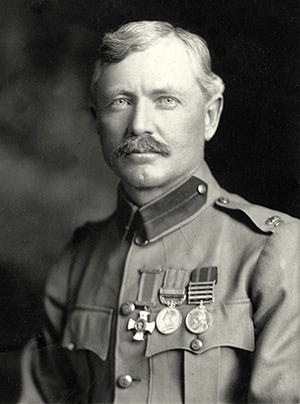
Copper was also a devout historian. He read and studied endlessly. It is highly likely that upon settling in Yavapai County, Arizona, when he established the Gunsite Ranch, Cooper became aware of a historical figure that operated in that area during the latter part of the 19th century. A man by the name of Frederick Russell Burnham, who was also known as the “Chief of Scouts” and “He who sees in the dark.”
Burnham
When it comes to the meaning of the word “scout,” names of real men like Kenton, Boone, and Carson come to mind. The term will also remind those with a background in early American literature of James Fenimore Cooper’s Natty Bumppo, aka Hawkeye. This fictional character spoke of his “scout” rifle, “Killdeer” as though it had mythical powers.
Two names often forgotten when it comes to scouts are Robert Baden-Powell and Frederick Russell Burnham. Most of the gunny persuasion know who Kenton, Boone, and Carson were. Powell and Burnham are not so well known today. However, in their time and up until WW II—during which a new era of adventurers and heroes were made—Powell and Burnham were newsworthy characters.
Robert Baden-Powell, a lieutenant general in the British Army, wrote a book for boys about reconnaissance and scouting in 1908. That book was based on his earlier books about military scouting, with influence and support of Frederick Russell Burnham who was the Chief of Scouts in British Africa. Two years later Powell would found the Boy Scouts Association.
Though a Major in the British Army, Frederick Russell Burnham was an American. Born on an Indian reservation in Minnesota in 1861, Burnham learned the Indian way as a boy and by the time he was 14 was supporting himself in California. It was there he learned the skills of scouting —not boy scouting but real scouting—from some of the last frontiersmen of the American Southwest.
In the early 1880’s Burnham relocated to the Arizona Territory and became a participant in the Pleasant Valley War, a feud between families of ranchers and sheepherders. [These bloody conflicts occurred east of Paulden, Arizona—the Gunsite Ranch—in Gila, Apache and Navaho counties.] He managed to extract himself from this and worked as an Army scout during the Apache Wars. With the adventurous seed sewn, and being totally enamored by Cecil Rhodes, Burnham took his family to South Africa in 1893 and enlisted in Rhodes’ service.
Burnham’s exemplary service and accomplishments as a scout in Rhodesia and later in South Africa were unparalleled. He became regarded as possibly one of the greatest scouts of all time. In fact, he was anointed “Chief of Scouts” for the British Army during the Boer War and, King Edward VII formally bestowed him with the rank of Major. While working with Powell during the Second Metabele War in Rhodesia, Burnham taught Powell valuable outdoor skills he had learned in the western United States.
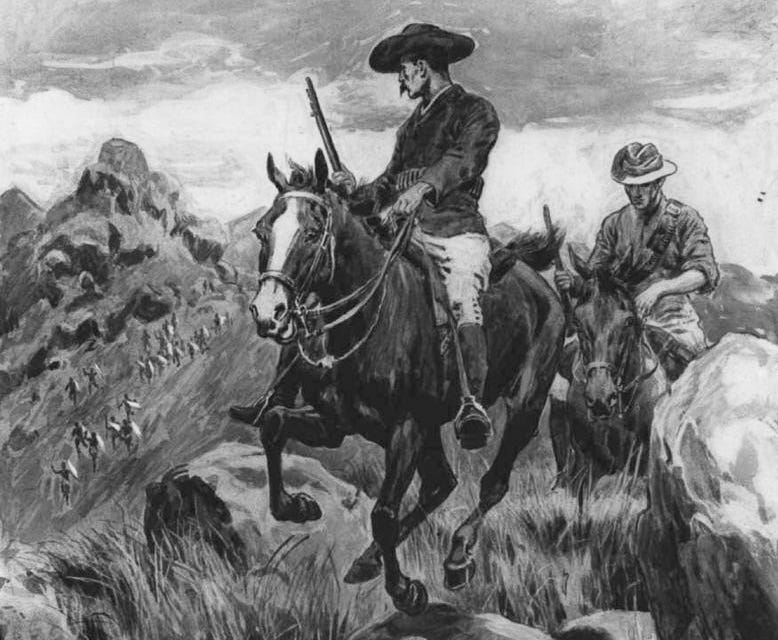
During both the Metebele and Boer Wars Burnham did the exact things Cooper would later describe as being the forte of the Scout Rifle. And like with Burnham, Rhodesia became a part of Cooper’s life; not only did he hunt there, but he also worked there in a consulting, armed capacity. Cooper devoted an entire chapter of his book, Fireworks, A Gunsite Anthology, to Rhodesia.
Cooper’s father had introduced him, “…to the works of Sir Henry Rider Haggard – King Solomon’s Mines and Allan Quartermain.” Haggard and Burnham were acquaintances, and [it is thought latter versions] of the Quartermain character [were] ultimately, loosely based on Burnham. [According to Cooper’s daughter] “Jeff read Stewart Edward White, Theodore Roosevelt, and then on his 16th birthday, his father gave him Ernest Hemingway’s Green Hills of Africa.” This leaves little doubt about the influence on Cooper during his formative years.
In Cooper’s Book, To Ride, Shoot Straight, and Speak the Truth, he credits the title to Herodotus of the 5th century and suggests the, “…lines were cherished by Theodore Roosevelt.” He goes on to say, “This book, therefore, is not for the trepid, the faint of heart, the soft, nor the overcivilized. It is, on the contrary, for those who aspire to command of the unruly environment in which they now find themselves.” [If you are going to read only one of Cooper’s books, I consider this one the best.]
Interestingly, in a letter from Africa addressed to his Uncle Josiah Russell, Burnham suggested, “If young Americans asked Josiah what Burnham thought about emigrating to Africa, he said to tell them, ‘That if they want to come to Africa to heap up a pile and go home again to live, that we can do our own blood sucking without help and I hope they will stay away. But any man who finds himself crowded and wants to help build up a new nation of Anglo Saxon people in this great Continent, come, he will find friends and plenty of work, rough and hard, maybe—for that is the proof of the man—if he won’t work hard at home, we don’t want his worthless carcass here. We want men not paupers—or Mamma’s darlings. We want men who can plow and live hard, shoot straight and ride well—for them there is room.” Burnham also instructed Josiah, who was caring for his young son Roderick, that, “He wanted his son to know how to ride and shoot, swim and fish, sail and row.”
In 1994 Cooper wrote, “Probably the first scout one is likely to think of today is Major Frederick Russell Burnham, the American who distinguished himself in both Arizona fighting the Apaches and later in Rhodesia and South Africa. His definitive work, Scouting on Two Continents, gives us a dramatic and enlightening picture of what a scout was and how he operated.”
Let’s alter this quote slightly, swapping Cooper’s experiences with those of Burnham so we can appreciate the parallels between these two men.…the American [Cooper] who distinguished himself teaching people to fight in Arizona and later in Rhodesia and South Africa.
In Cooper’s book, C-Stories, he dedicated an entire chapter to Burnham and at the end remarked, “The term ‘hero’ is far too loosely applied today and is casually used to denote almost anyone who encounters any sort of danger, or even discomfort, for a good cause. So, we should come up with a better term for Frederick Russell Burnham. He was a true, classical hero and should serve as an inspiration in an age when the common man is extolled above his merits.”
In October of 2005 Cooper wrote, “Frederick Russell Burnham was particularly proud of his title of ‘Chief of Scouts’ under Lord Roberts in the Boer War. The scouts, of whom Burnham was chief, were frontiersmen only coincidently. A ‘scout rifle’ should be a rifle for such a man.” [If you would like to learn more about Burnham I suggest you read his excellent book, Scouting on Two Continents, or the biography, A Splendid Savage, by Steve Kemper. Both books are captivating and excellent.]

White
Another man who Cooper read and respected was Stewart Edward White. White was an early 20th century novelist and adventurer. He was also purported to be an extraordinary game shot with a rifle. In The Art of the Rifle Cooper wrote that he felt White was a “Certified Master of the Art” and he offered this compliment based on the fact that White’s talents had been analyzed by E.C. Crossman, who according to Cooper, “…was one of perhaps a half–dozen truly authoritative ‘gun writers’ of the 20th century.”
Crossman, who had written books about military and sport rifle shooting, worked with White and discovered that, “White could not get into what Crossman regarded as a satisfactory shooting position, and he knew nothing about the shooting sling.” But even though White could not shoot small groups, “He could keep all his shots in a four-inch ring at a hundred steps under all conditions of light, speed, and position. Calm or out of breath, lying down or standing up, in a slow fire or in a hurry, White’s shot always landed within two inches of his exact point of aim.”
Cooper proclaimed that, “This sort of thing will win no medals in competition, nor will it be extolled by the advertisers, but it will do what needs doing—and it will do it every time.” It was clear Cooper held White’s ability in high esteem but there is more to the story.
In 1915 Stewart Edward White published the book, The Rediscovered Country, this memoir chronicled the adventure of White and R. J. Cunninghame into German East Africa in 1910-1911. [Cunninghame led President Rosevelt’s excursion into British East Africa] During their adventure, which could well be considered an extended scout, White and Cunninghame made maps, hunted, explored, and interacted with the native population. White alone, given his armaments at the time—a 1895 Winchester in 405 and a Springfield—racked up an amazing tally of game. “Animals shot at: 176, Animals killed: 152, Cartridges fired: 303, Hits made: 241.” [Though I would not consider this book extremely well written, and the narrative can bog, it offers fantastic insight into the early 1900s in wild Africa.]
During this safari White had the opportunity to became engaged in a gun battle with four lions and described it as such:
“This is, in my opinion, the supreme moment in a hunter’s life, the moment when, all preliminaries at an end, the lion makes his direct and deadly attack. The little unessentials are brushed aside. Only remains the big primitive idea to fill all a man’s mind—kill or be killed. The preliminary maneuverings have made him nervous and jumpy enough to scream aloud; but now all his faculties fall into battle array. He becomes deadly cool. Each of the few movements necessary to bring his weapon into play he executes with what seems to him an almost deliberate precision.
A smoldering, repressed emotion fills all his being; it is not exactly anger, but something like it, rather a feeling of antagonism, a pitting of forces and skills. He delivers each shot with an impact of nervous force behind it, as though he were to strike with his own hands. ‘Take that!’ his mind seems to itself to mutter; though of course he has really no time nor attention to waste on articulation. And beneath all this is a great wary alertness that sits like a captain in a conning tower, spying cannily over all the situation as it develops, poised ready to plan competently for the unexpected. Excited in the usual sense of the word? No. But alive to the uttermost of all his faculties at once? Yes. That is why the moment is supreme.”
The similarity between White’s description of being engaged with dangerous game in his book, The Rediscovered Country, and what Cooper wrote in a chapter entitled “The Spice of Life” in his 1992 book, Another Country, cannot be ignored.
“Fear that nullifies a man’s ability to cope with the danger which gives rise to the fear is an unacceptable emotion. The awareness of peril, however, is not the same thing at all, because in properly organized personalities it heightens perceptivity, sets the heart and mind to greater activity, and stimulates the entire consciousness in a way not otherwise realized.”
During White’s lion “war” if you will, White hit one lion three times, with the last shot delivered at eight paces. He hit one of the other lions four times, the smallest lion twice, and the largest one seven times. White used both of his rifles during this engagement and his faithful gun bearer stood behind him alternately loading them as the fight wore on. White wrote, “…as after one or two shots I always handed them back for reloads, desiring always as full a magazine as possible.”
Whelen’s work entitled, The American Rifle, where he details a practice or training regime of White’s. This, what might be called a rifle workout, was well ahead of its time in 1923 and illustrates an exercise that you would be hard pressed to prove did not influence Cooper’s rifle shooting doctrine along with his perceived duty of a Scout Rifle.
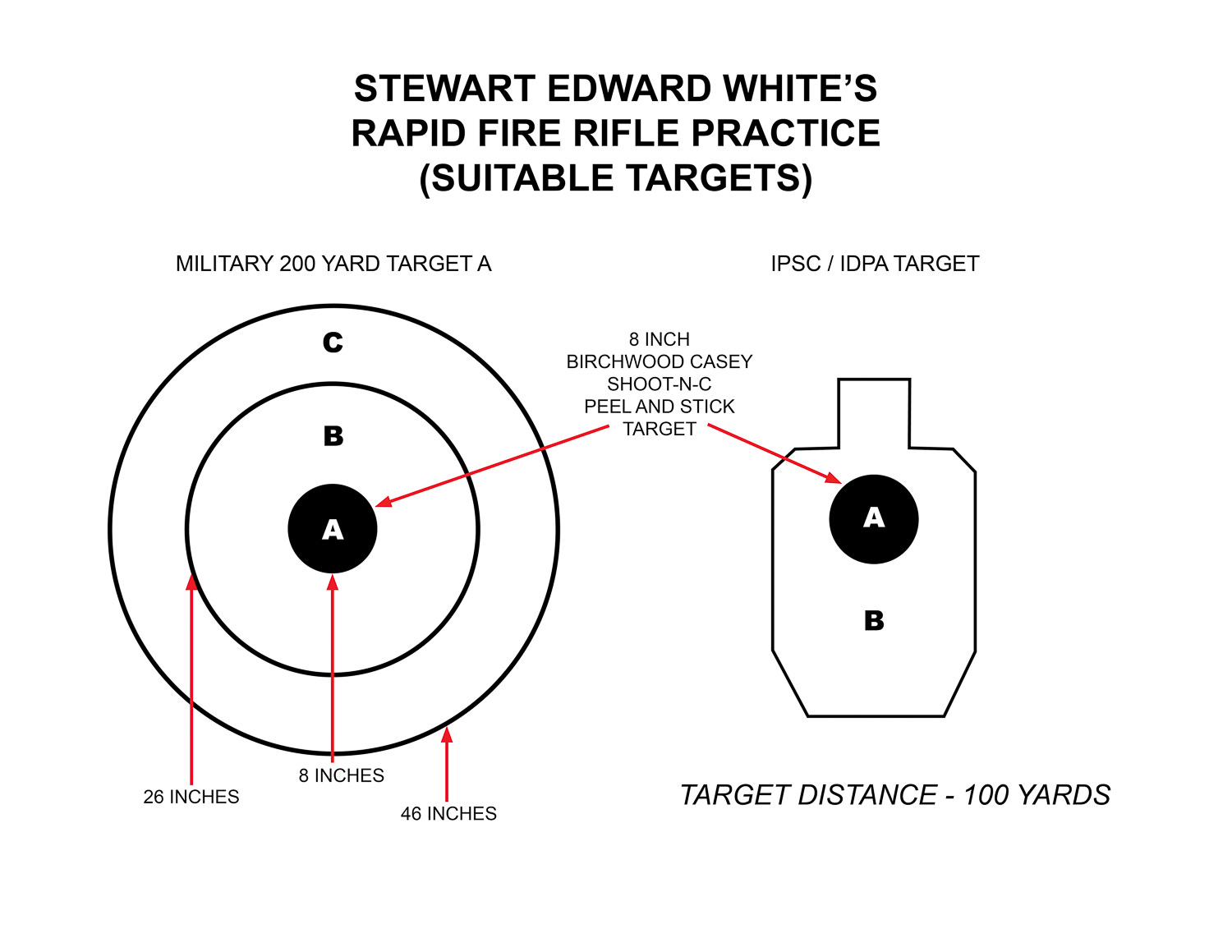
To try White’s drill, you’ll need to set up an ordinary military 200-yard rifle target A at 100 yards. This target had a center bull measuring eight inches, surrounded by a 26-inch ring and a 46-inch ring. Starting with the rifle buttstock below the elbow, on signal the shooter fires one timed shot. This is repeated four times for a total of five shots. Then, individual times for each shot are added up and the target is scored based on the following table.
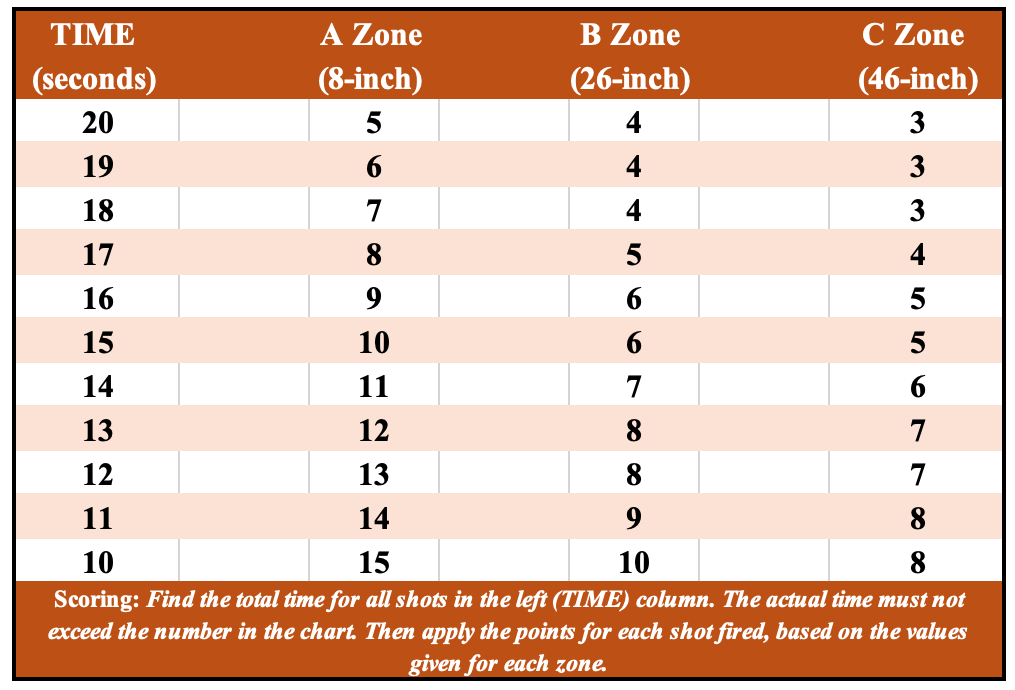
The key to a good score is the balance of speed and accuracy and this drill and training concept very likely laid the foundation for Jeff Cooper’s emphasis on, and infatuation with, the “snapshot.” What I really like about using this drill as a training tool is that it gives you no credit for near misses; you must get inside that eight-inch circle to score well. I also like the importance of time because with any application of the rifle when solving real world problems, time will always be a part of the equation. It’s worth noting that on the signal you could assume any intermediate position you choose. Doing so might allow better hits, but you’ll be penalized heavily on the time scale.
Given that the military target A went out of style years ago and given that if you cannot keep your shots within a 26 inch circle at 10 yards, what you really need is basic rifle training. As a modern target alternative, I suggest a common, cardboard IDPA or IPSC target. Place an eight-inch Shoot-N-C peel and stick target in the high chest area for the A-zone. The remaining target makes up about the same surface area as the 26-inch circle B-zone of the A target. Disregard the C zone; a shot off target is fully deserving of being described as a miss.
You could also use this drill as a qualification course. White suggested any man should be able to score about 20 points in 18 or more seconds. By that estimation we could assume twice as many points (40) should qualify one as a marksman. 55 as sharpshooter, 65 as expert, and a perfect score of 75 would earn a distinguished rating. [A perfect score would require hitting the eight-inch bull five times within 10 seconds total—two seconds per shot. There is no other way to define this other than snap shooting.]
To any hunter or rifleman, it is clear White’s encounter with the lions was the highlight of his German East Africa adventure. Without question it is the best few pages of reading in this chronological account. In Cooper’s similarly titled, Another Country, his lion hunt is saved for the last chapter, “Close Encounter,” of that book. This hunt led to the naming of Super Scout IV as “Lion Scout” and it parallels White’s close encounter.
Before anyone jumps up with fists clenched suggesting I’m accusing Cooper of plagiarism; that’s patently false. I am simply illustrating that there were men—good, hearty, robust men of character—who had great influence on Cooper. The purpose of this treatise is not about the kind of man Jeff Cooper was, it’s about the Scout Rifle he spent so much of his life trying to perfect. To ignore the historical influences that inspired his concept, would not do justice to it at all.
Could all these similarities be coincidence? Possibly. Could Cooper’s words and actions, with relation to the Scout Rifle have been subconsciously inspired by the words of these men from when he read their works? Possibly. What’s more likely is that Cooper had immense respect for these men and was deeply persuaded by them. He was human and like all of us who are inarguably so, the influences in our life can be found in the way we live it, the work we do, and the actions we take. Just as Burnham and White influenced Cooper, so has Cooper influenced many, including me. His writings will continue to do so for as long as words remain in print.
If all this is true, why did Cooper not give Burnham and White credit for the Scout Rifle and its concept like he did with Weaver and the stance? Firstly, unlike Weaver, Burnham and White did not originate the concept. Secondly, Burnham and White were practitioners of a craft, not a specific technique or weapon system. And, lastly, in a way, Cooper did give them credit. Cooper’s legacy rifle, the Scout Rifle, was so named for a reason. If you look at Cooper’s often explained purpose of the Scout Rifle, it is more than clear he was conceptualizing a rifle that would have been ideally suited to the activities Burnham and White participated in.
[As Cooper once wrote] “…the old-time scout would be much better provided with what we have come to call a “Scout Rifle” today than that which he was given at the time.”
Cooper conceptualized a rifle for a specific breed of men—Scouts.
The Scout Rifle has survived and continues to be relevant, now more than 40 years since Cooper introduced us to it. What many have been waiting for is the perfect representation of Cooper’s concept to materialize. Maybe—hopefully—we might see that manifestation during the upcoming World Scout Rifle Shoot at Gunsite Academy very soon. I know of at least one new yet to be announced Scout Rifle from a respected manufacturer that will be there. I have seen pictures of it, but have not handled it. Who knows, maybe, Burnham, White, and Cooper will be watching.
