

The Problem with Jackals
Africa’s least respected trophy

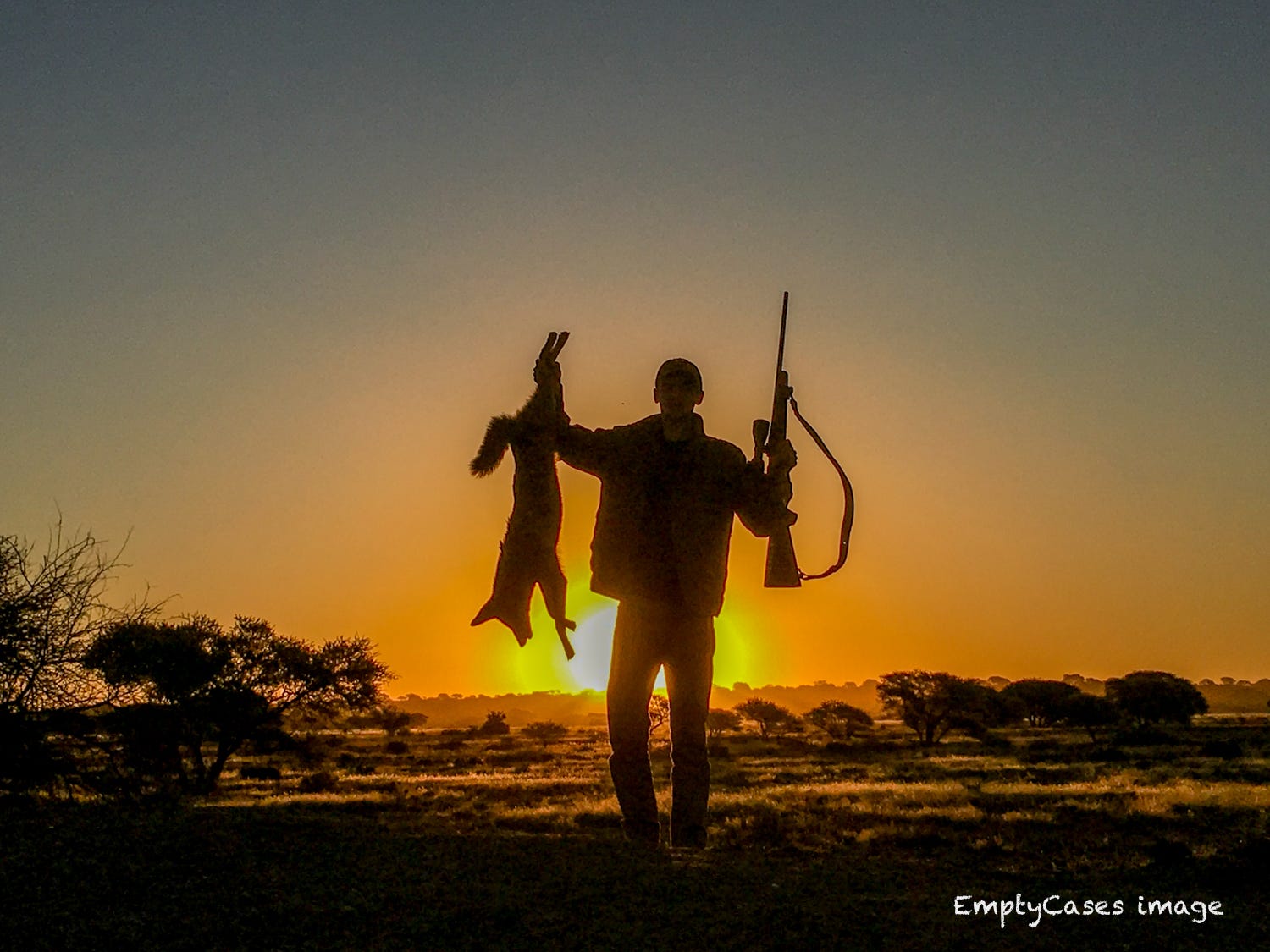
I really enjoy predator hunting but I don’t do it all the time. I like to ration the experience so it maintains—pardon the pun—its bite. I hunted jackals during my first African safari, though I’m not sure you could really call it a hunt.
I’d taken a predator call with me like I do on almost every hunt no matter where I go, and I’d asked the professional hunter about trying to call jackals. This was more than two decades ago before calling jackals was as popular as it is now. He’d had no experience with calling them and suggested we go out late at night and give it a try. So a bunch of us loaded up in the back of a Land Rover and headed out into the Limpopo darkness.
We just stopped the Land Rover in a road in some semi-open country and I put the call out and turned it on. About five minute later the man in charge said. “Get ready.” and he turned on the spot light. Jackals were everywhere and everyone went to shooting.
The problem was, we did not know what we were doing and apparently nobody could shoot either. The only damage sustained was to our hearing—no one hit a damned thing.
Back then few outfitters wanted anything to do with calling jackals because it added more hours to an already long day. But several years later on another safari in Limpopo a friend and I found a PH who knew something about it and we tried again. The call had not been screaming long at all and here came the jackals. The problem was, the jackals were not jackals at all. They were bat eared foxes and bat eared foxes are protected.
A week later I gave it another go in the Northern Cape during my son’s first safari. We found a depression much like an inverted pitchers mound in an opening at the base of a rocky mountain. A ten foot tall acacia was growing out of its middle making for us the perfect hide. My son, our PH, and I crawled into our sort of fox hole and I turned on the screaming jackrabbit call and the little wiggly fur ball of a decoy.
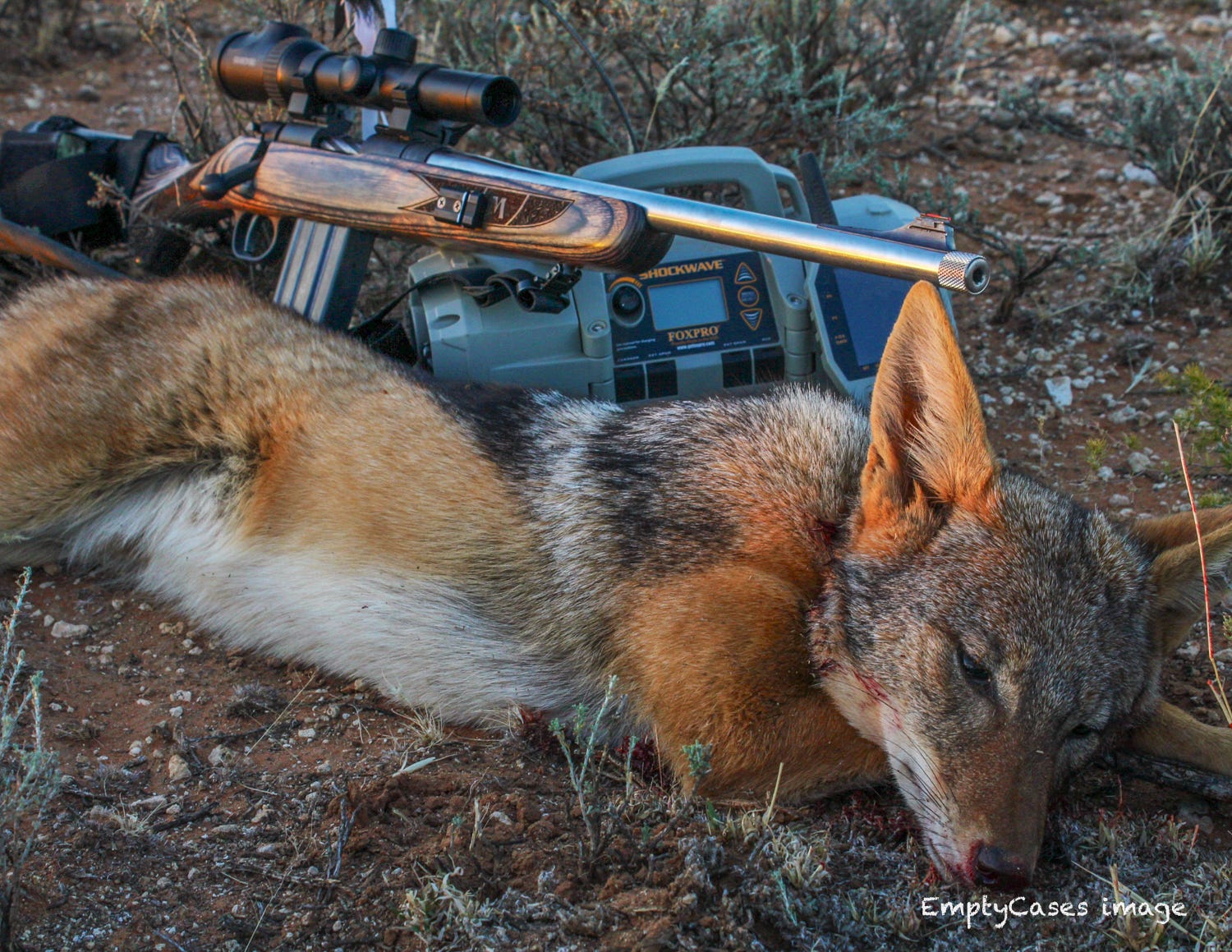
In no time at a all a falcon landed beside the decoy, and then another falcon landed on the decoy, wrapped his talons around it, and took off. About four or five feet off the ground the falcon either decided what he had was not edible or realized his flight manifest was wrong, and he dropped the four-pound FoxPro Shockwave call. That was unexpected and exciting but the two jackals that I’d noticed charging our location at the same time was exciting too.
They stopped at about 100 yards and Bat—my son—busted one of them with a little Mossberg bolt action rifle chambered in 25-45 Sharps. Overcome, Bat yelled out, “Can we do that again?” Of course the problem with jackals is that calling them does not always include an air assault—it can be exciting but that event was singular in many ways.
A couple years later I was back in the Northern Cape again with plans to hunt buffalo but as always I had my predator call with me. I also had a nice Merkel double rifle in 375 H&H. One evening when we were preparing to head out to call jackal, one of the professional hunters in camp asked if he could come along and try to smack a jackal with the big double gun. Of course I agreed and we headed off into the African sunset.
I put my son and the PH on one side of an embankment with the double rifle and I set up on the other side to watch our back side. Not three minutes after I turned the call on I heard the big double sound off—and then the second barrel. I figured he’d got two jackals so I turned the call off and scooted around the embankment to find the PH there grinning. The problem was, he’d missed one jackal twice at about 20 yards. He said, “He ran right in on us, stopped and looked at us. I rushed—and missed—and he just stood there so I thought I might as well miss him a second time.”
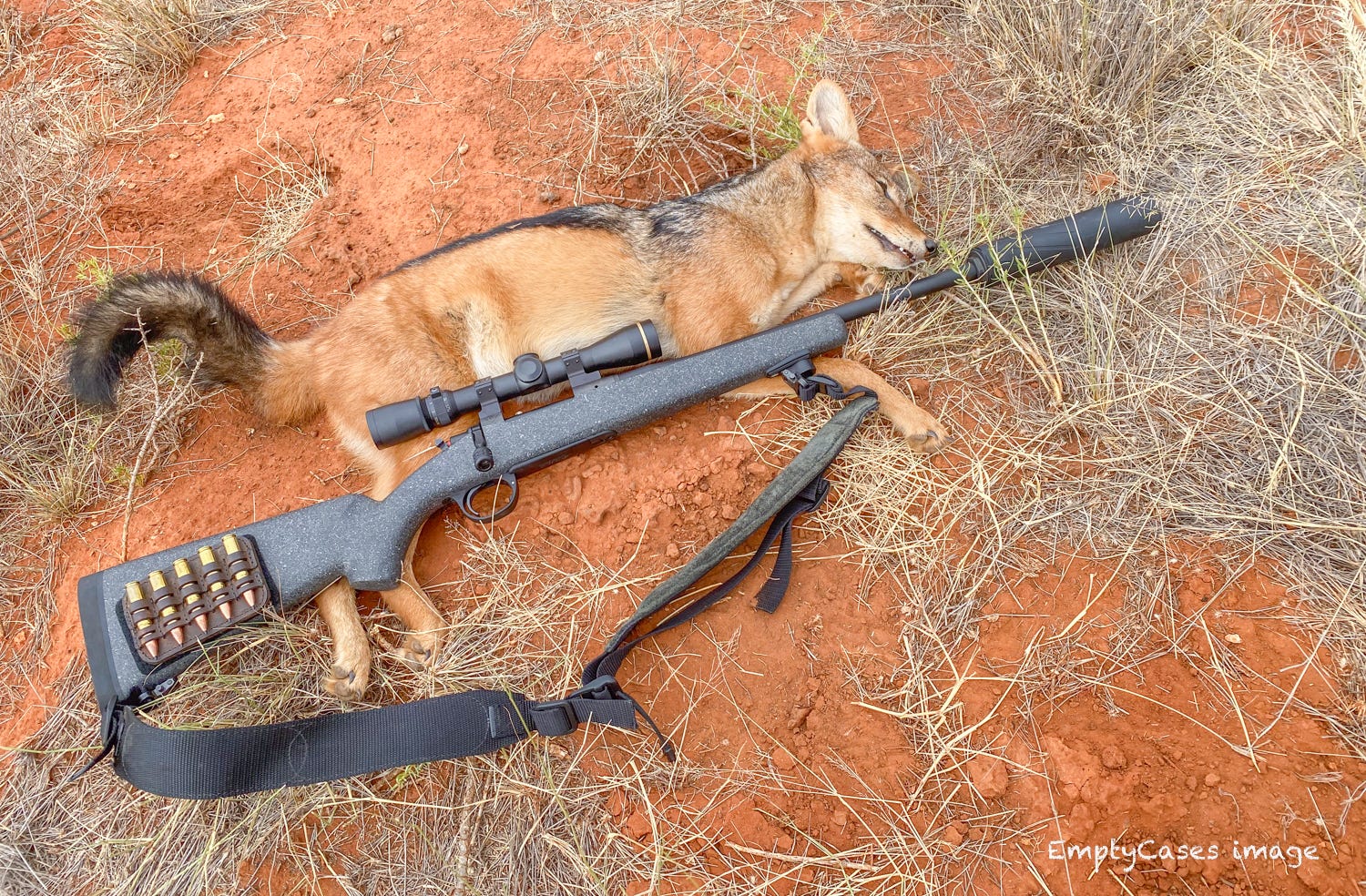
Later during that same safari Carlos Martinez who was running the Remington Custom Shop at the time said he’d like to go call jackals. So several of us went out and stationed ourselves around a big stock tank surround by brush. It was a perfect set up and we had the country covered 360°.
Just a few minutes into the calling a jackal popped up at about 200 yards and the PH beside me—who’d decided to go with us at the last minute—missed. Admittedly, it was a hard shot, you could just see the jackal’s head above the grass. I whispered, “He’s still there, shoot again.” but nothing happened. I looked over at my companion who was trying to unjam a $5000 rifle from Remington’s Custom Shop. After a couple minutes—the jackal had walked out in the open now—he handed me the rifle and said, “You shoot the damned thing.”
During the day the PH had been hunting with Carlos who was using a 7mm-08, and the PH had been carrying his extra ammo. The problem was, the rifle he had been handed for our jackal calling was a 6.5 Creedmoor and the PH had mixed up the two cartridges when loading the magazine. For those who may not know, you cannot chamber a 7mm-08 cartridge in a 6.5 Creedmoor rifle, no matter how much the rifle cost.
On another escapade during that safari another hunter asked if I would take him out for a long walkabout in the free-range country to see what we might turn up. We covered about three miles and just as the sun was slipping its tangerine colored self behind the African horizon, I suggested we try to make a set for jackal. I had my call in my pack and we found a cozy position with me just behind and slightly above the hunter.
As with most of my experiences jackal hunting, the jackal often come quick and this one did—straight at us and at a run. He stopped about 10 yards away looking me right in the eye. I kept urging the hunter to shoot and even kicked him in his backside thinking maybe he was having some sort of moment. Finally the jackal got tired of our silliness and ran off. The problem was, the hunter was just enough below me that a rock had blocked his view of the jackal’s approach and the following standoff. As close as it was he never saw it.
Near the end of that safari and in an attempt to solve their jackal killing frustrations, all those who had failed to kill a jackal asked for another go. I agreed, but I insisted my son come with us for two reasons. First, he had been working most of the entire safari and the only thing he’d been shooting was a camera. Second, I was tired of these fools blowing perfectly good jackal killing opportunities.
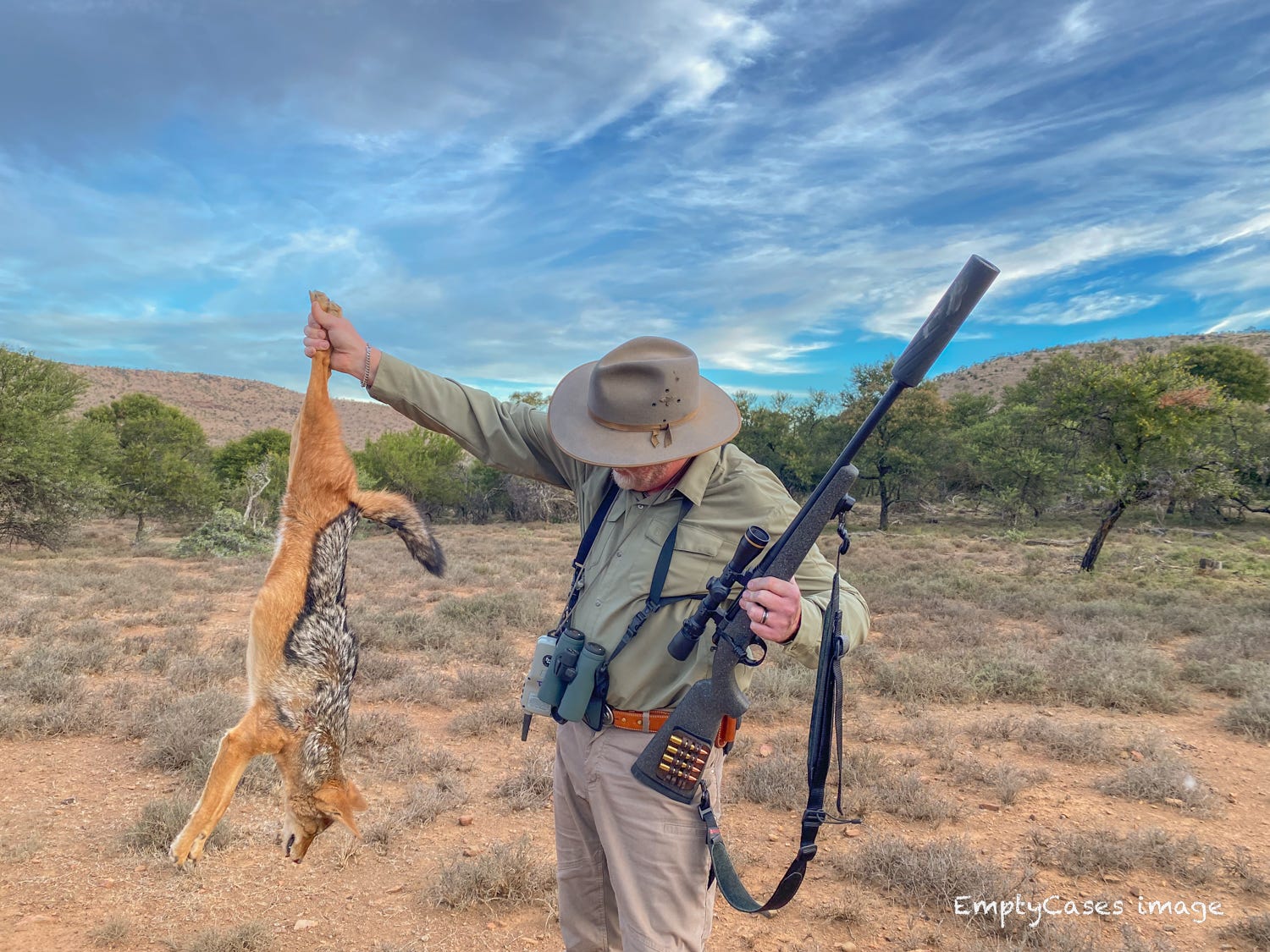
Just before dark we drove to a spot that had once been several man made ponds. They were empty except for some mud the warthogs liked to waller in, but the embankments around the ponds provided great hull down shooting positions for calling jackals—your head and rifle would be all they could see—and we had five hunters to hide. I strategically placed everyone, and my son and I took the least favorable spot.
As is most often the case, in less than five minutes we saw jackals—two of them—coming in hot. They hit the far embankment of the ponds and ran its length, stopping along the way to look and smell. I expected to see one of them explode at any moment because everyone in the party was armed with a big game rifle. It never happened, and when the two jackals reached the end of the last embankment, I told Bat to shoot. He killed one and the other one hightailed it.
I think all the other hunters thought I had prearranged everything so my son would kill the jackal. The thing is, they all saw the jackals but just could not aim and shoot fast enough. Those hunters clearly never comprehended the problem/s with jackals.
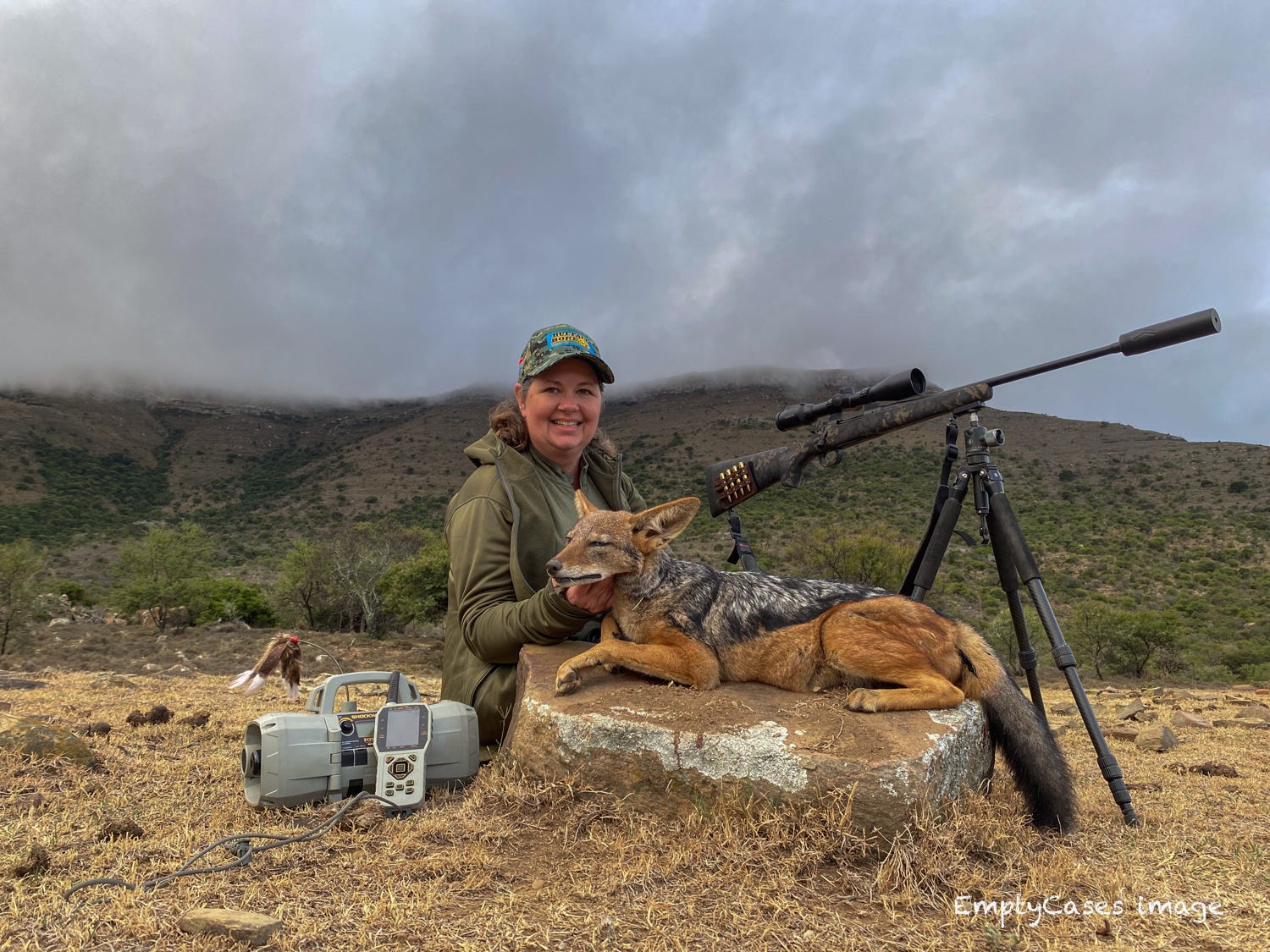
The problem with jackals is that they are treated almost like bonus animals by most who go on safari. Sure, you might be driving around and see one and shoot it, but that’s not the same as calling it in. These are smart wily creatures that—just like you—are hunting when they come to a call. When you’re calling them you have to be ready, you have to treat them with respect—you can’t just stumble around with a 10-pound double rifle, the wrong ammo, or sit behind a damned big rock you cannot see over.
But also, you gotta be able to shoot. Jackals are not very big and when they stop moving they don’t stand around very long. You have to aim—fast—with more precision than you do for a shot on a kudu, a wildebeest or a buffalo. That’s part of the problem with jackals.
The real problem with jackals is that they are not as revered as the common plains game animals everyone goes to Africa for. The very real problem with jackals is that safari hunters with thick pocketbooks, expensive rifles, and big egos just don’t give them enough respect. It’s a shame really, calling jackals has given me some of my fondest African memories and I respect the hell out of jackals, otherwise I’d pay them no mind.
NOTE: If you are going on safari I’d suggest you discuss calling jackals with your outfitter. For the trophy fee/s you’ll get a hell of a lot more—excitement—for your dollar than you will with most any other African animal. And if you have the right gear and a savvy professional hunter, you can call, see, and shoot a lot of them. During my 2024 safari I killed five and called in twice that many more for other hunters.

We are trying to put something together for 2027. Geoffrey is actually in country -- Texas -- now.
Even in the dark :)