

A Poor Man's Magnum
Chapter 41: 35 Whelen

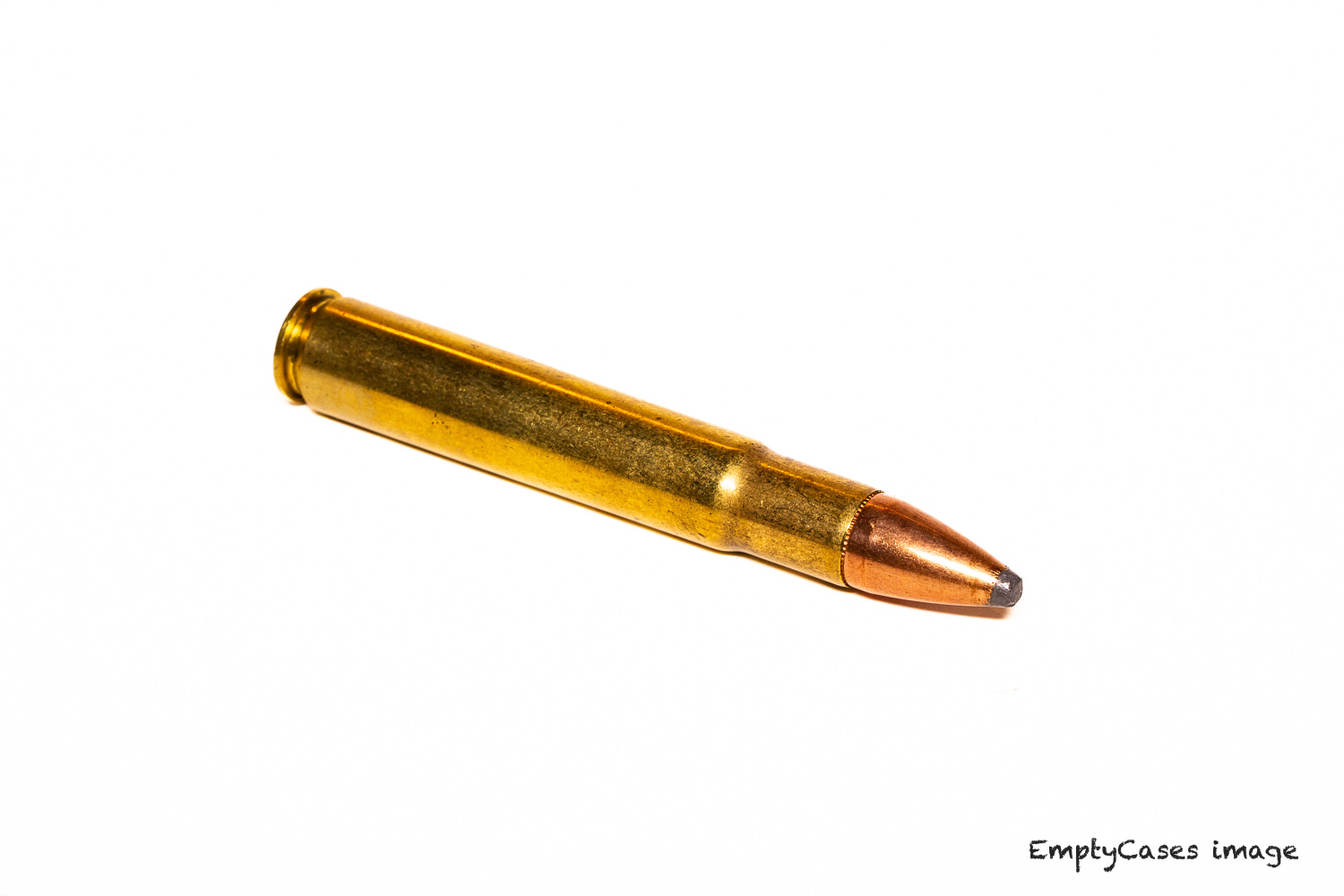
This is an excerpt—Chapter 41—from my latest book, Rifle Cartridges for the Hunter. It provides a glimpse of what you can expect to find in the other 49 chapters.
In 2013 I shot my first kudu and black wildebeest with a 35 Whelen, but that’s not where my experience with the cartridge began. I purchased my first 35 Whelen more than two decades prior to that. It was special run of your common variety Ruger 77. The rifle shot about like you would expect a Ruger 77 to shoot. If I did my part, with loads it liked, it would print three-shot groups of around an inch. On its first trip to the woods, I was sitting a tree stand over a hardwood flat covered in laurel. It was around mid-day, and I did not expect a lot of activity so the doe that came crashing by caught me by surprise. As she passed near my tree at about 30 yards, I poked her through both lungs with a 225-grain Nosler Ballistic Tip and she collapsed.
Excited I had meat on the ground, I was preparing to climb down when I caught movement. A spike buck was headed my way in a hurry. Apparently, he’d been trailing the doe. Just as he was approaching my tree—and the dead doe—he caught scent of, or saw something, he did not like, and he made a hard left turn and increased his speed. When I pulled the trigger, I knew I did not lead him enough, but on impact he became unstable and looked like a drunken hobo. He staggered for about 10 yards and hit the ground, motionless.
The ground around my tree stand was covered with about an inch of fresh snow and the area around both deer looked like a murder scene out of a serial killer movie. I’d never seen that much blood on the ground. The bullets had hit both deer at about 2500 fps. The doe had taken the bullet through both lungs and the bullet hit a rib on exit. You could have pushed a baseball in the exit wound. I’d hit the spike clean through the guts, missing all the vitals but the internal damage was massive. Enough so that he did not live more than 10 seconds after the hit. At that time in my hunting career, I’d never seen a cartridge hammer deer with so much authority, and I’d never seen a gut shot deer die so quickly. I was impressed.

At about this same time I was finding a lot of work writing for gun and hunting magazines and this meant I was constantly receiving a lot of rifles to evaluate, and I was traveling to a lot of hunts. The 35 Whelen found its way to the back of my safe and lived there until I needed to raise some funds to purchase a different rifle—a CZ 550 FS in 9.3x62mm—which was a full-stocked rifle that was gorgeous; much better looking than the Ruger. But I was not done with the 35 Whelen.
In 2013 Melvin Forbes partnered with a company called Forbes’ Rifles to offer mass produced versions of his fantastic New Ultra Light Arms Rifles. Trijicon had invited me on safari in South Africa, and I reached out to Melvin to see if I could borrow one of the new Forbes rifles to take with me. It was early in the development of the Forbes Rifle company and at that time Forbes Rifles were machining the actions and sending them to Melvin to be barreled, chambered, and stocked. Even though those early rifles were marked as a “Forbes” rifle, Melvin was building them. Melvin said he had a Model 24B he’d just finished that was chambered for the 35 Whelen and he loaned it to me for the safari.
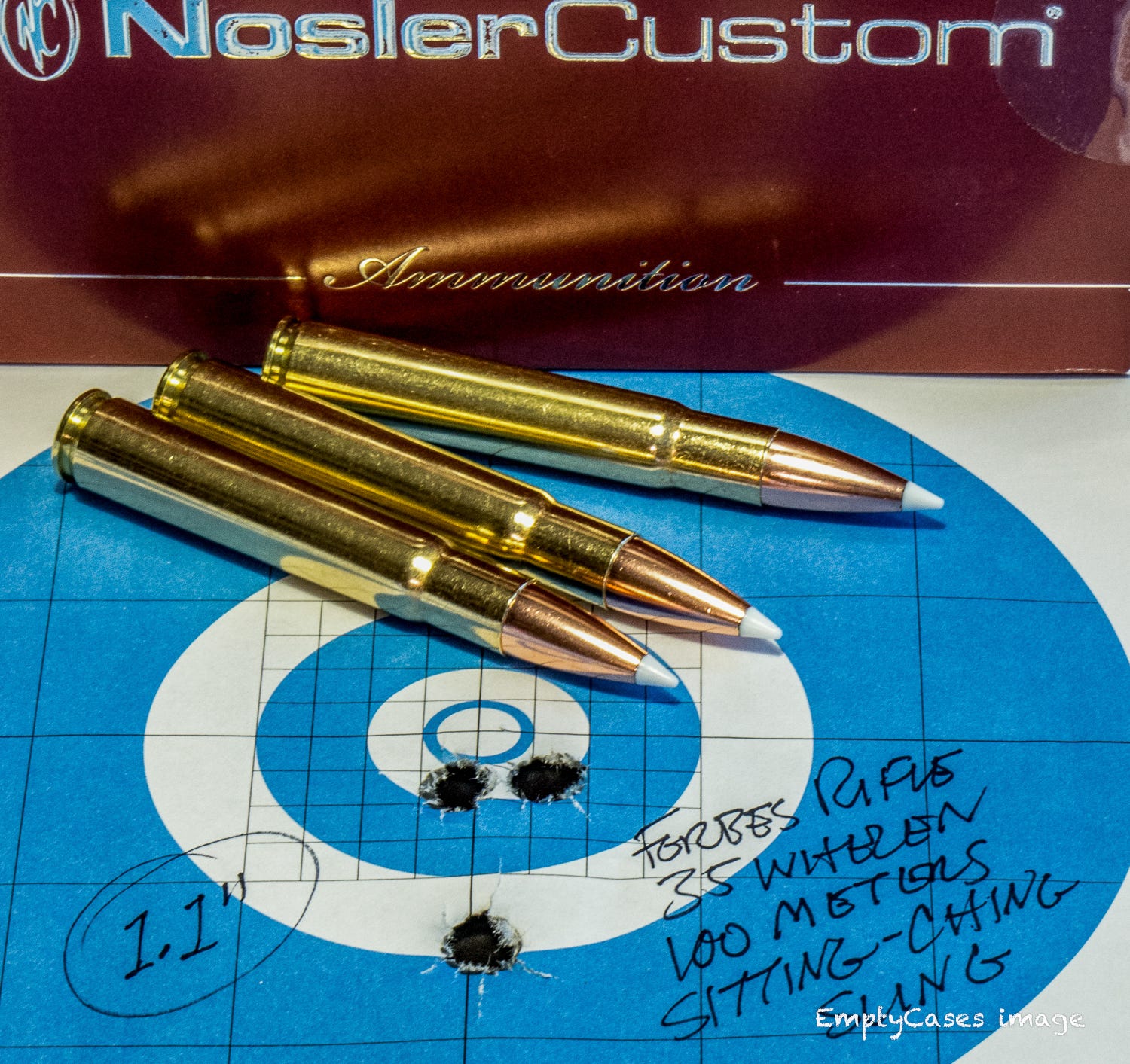
The load I selected for Africa was Buffalo Bore’s 225-grain Barnes TSX with an advertised velocity of 2800 fps, and out of the 22-inch barreled Forbes 24B, it averaged 2820 fps. If you could stand the 44 foot-pounds of free recoil energy the rifle generated, from the bench it would put three of those blistering TSX bullets into a cloverleaf at 100 yards—every frigging time. I did that a couple times and would rate the experience as unpleasant. After that, I only shot the rifle from field positions, and I used it to shoot the best three-shot group at 100 meters I’ve ever fired from the sitting position. It measured 1.10 inches.
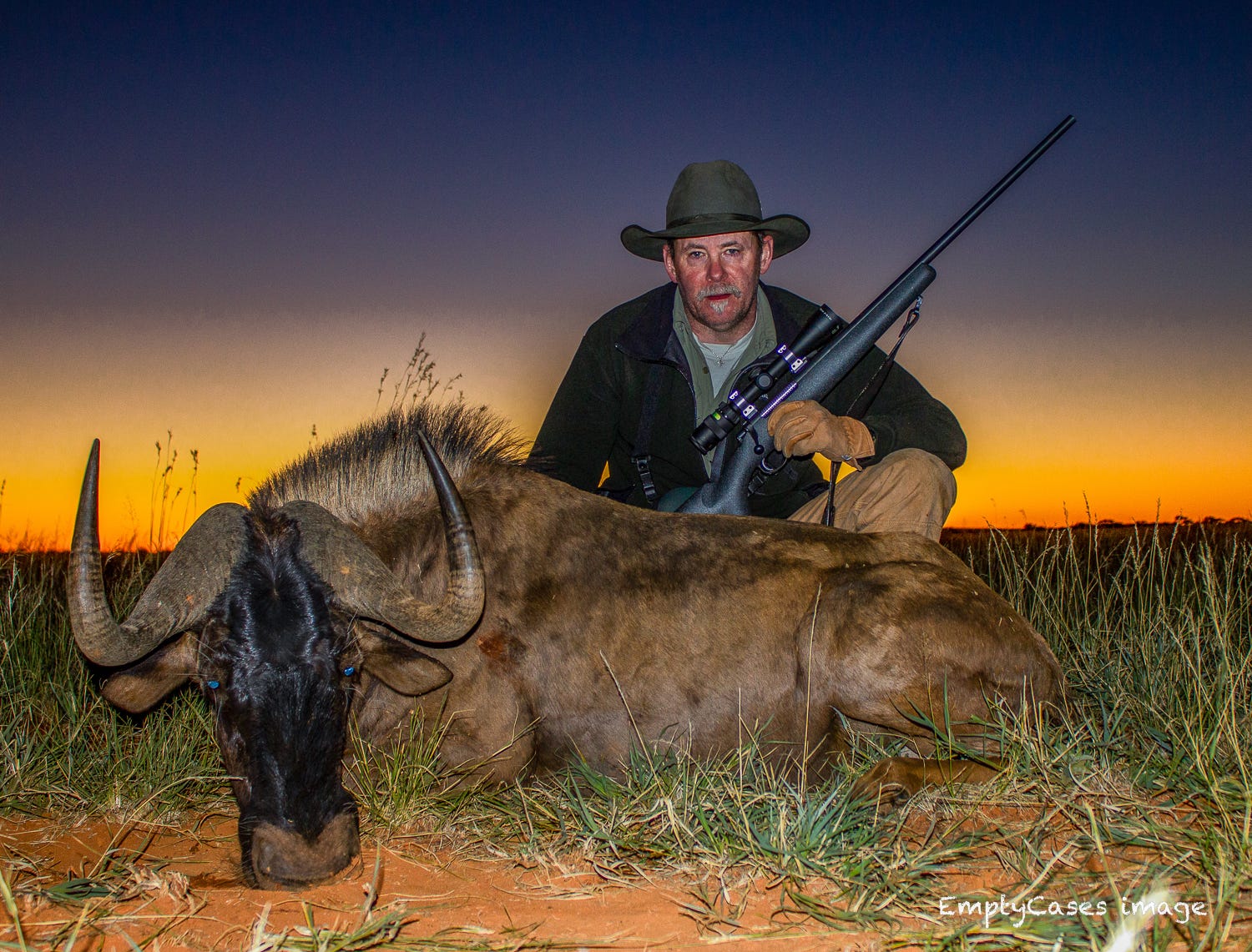
As well as I shot that rifle, I managed to miss the first animal I shot at in Africa with it. We’d crawled to within about 300 yards of a bunch of black wildebeest and I’d braced myself against a tree, slung up tightly in the sling, and just missed. The wildebeest thundered off and we regrouped and walked down to where they’d been, looking for any signs of blood. Convinced it was a clean miss, we were walking away when my professional hunter said, “Get down, here they come.” The 60 or so black wildebeest, as they sometimes do, had ran off, seen something they did not like, turned, and were heading right back towards us.
I quickly dropped into the seated position, slung up, and as good fortune would have it, the wildebeest stopped about 225 yards from us. My PH picked out a nice bull and when the glowing red dot found his shoulder, I pressed the trigger. I lost everything in recoil but Len Waldron, who was hunting with me, said the bull hit the ground like God had just repossessed his legs. The 225-grain Barnes TSX bullet had hit him on the point of the shoulder and passed clean through.
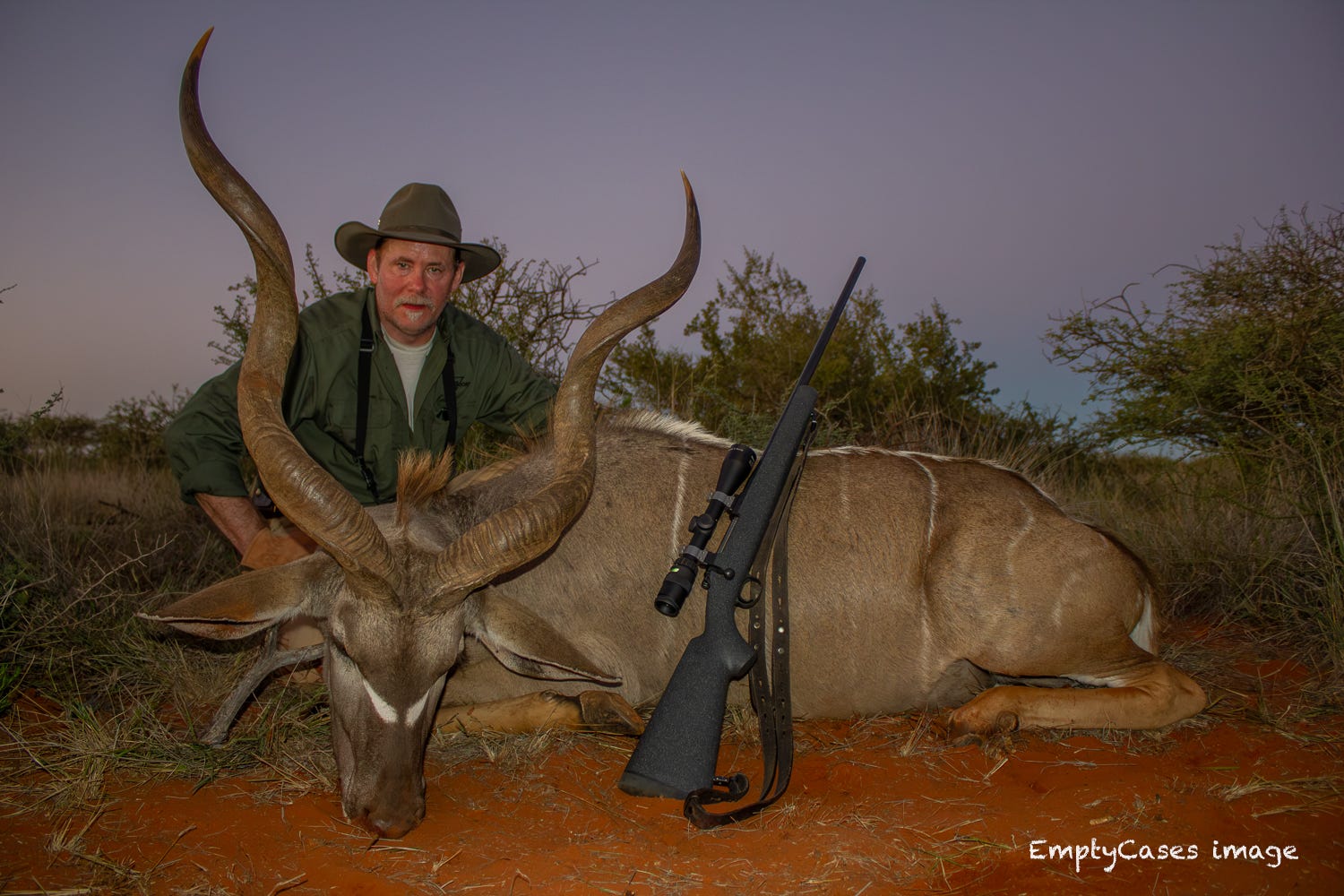
The next day we were on a mountain watching two nice kudu bulls. They were feeding our way through some thick and thorny acacia trees and the plan was that when they got to within 250 yards, I’d shoot one. At about 275 yards they decided they were going to turn around and go the other direction, so we climbed down and went after them. After an exciting stalk that included some running, crawling, and cussing, we finally caught one of the bulls in the open at about 125 yards. I whacked him with the Whelen, and he spun and ran. Based on my previous experiences with the Whelen I expected him to go down soon. He didn’t. Shot through the top of the heart, the kudu bull ran almost 100 yards.
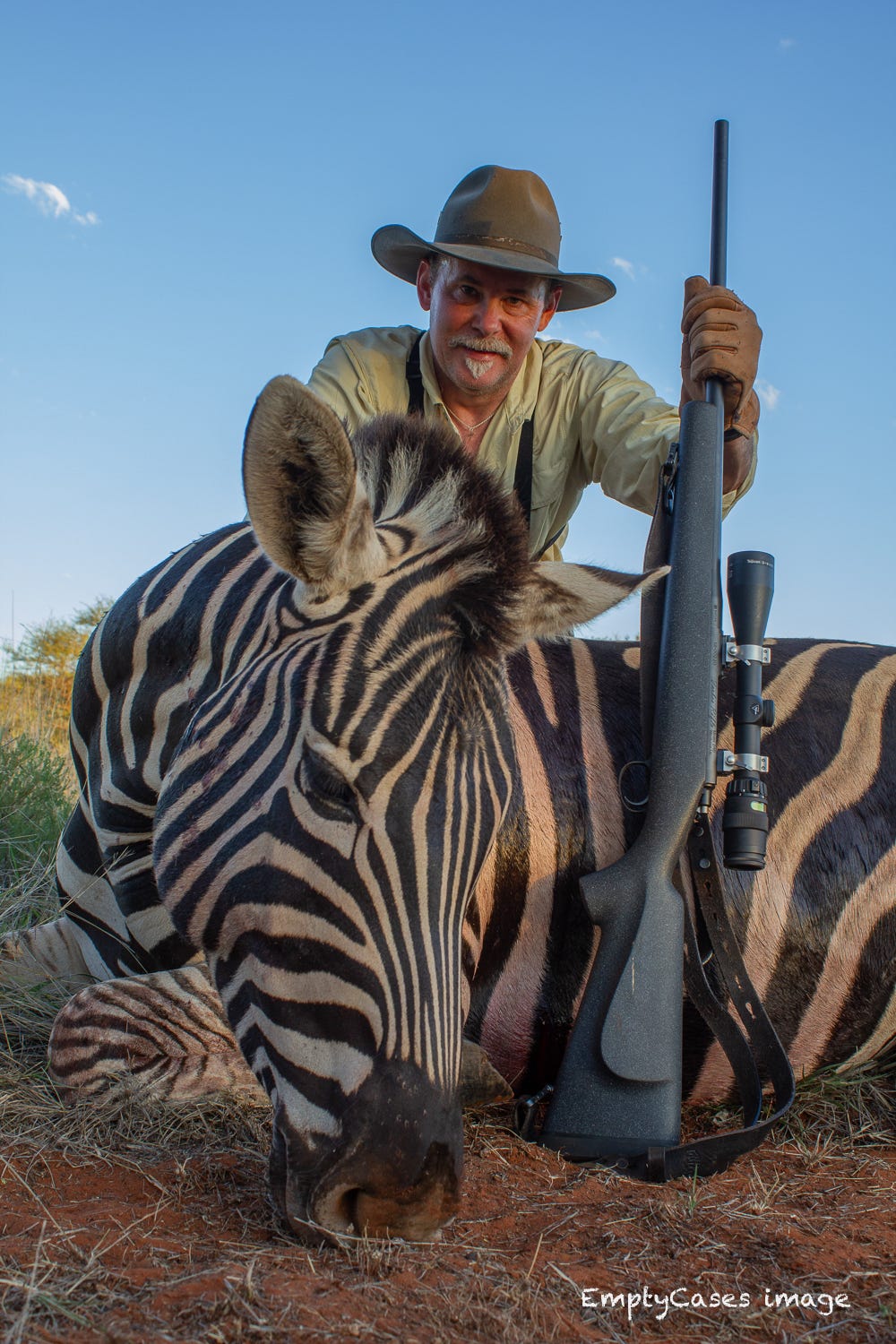
A few days later professional hunter Geoffrey Wayland and I made a long stalk on a zebra stallion. At about 250 yards we ran out of cover, and resting the 35 Whelen on an acacia limb, I shot the zebra through both lungs. He was not impressed. He ran about 170 yards, dropped, got up, and ran about 15 more yards before he finally went down and stayed down. Again, the bullet passed through, and the blood loss was extensive. So much so that while trying to take photographs we crammed a full roll of toilet paper into the entry hole trying to stop the bleeding.
That was the last animal I took with the 35 Whelen. The rifle was fantastic, and the cartridge was lethal, but by then I’d realized that for anything but dangerous game, I didn’t need that much gun. Not long after returning from that safari my best friend moved to Kodiak Alaska to run the Kodiak Baptist Mission on the island. Of course, big bears litter the island, and my friend needed a serious rifle—just in case. I sold him the Forbes 35 Whelen, and it turned out to be one of the best purchases he ever made.
The Mission there on Kodiak is an active farm and a school. They raise a variety of animals and educate children. So, critters and kids are constantly on the property. A brown bear had found its way onto mission property, and after killing one pig it was attempting to kill another. Ultimately, the bear ended up charging my friend and he shot it in the head with the 35 Whelen with a 225-grain Nosler AccuBond. That ended the bear, but it was just the beginning of the investigation. My friend said he believed the ordeal he went through with the State Police would not have been as bad if he’d shoot a human. Never underestimate the ideocracy of a government entity.
The 35 Whelen is nothing more than a 30-06 Springfield cartridge necked up to accept a 0.358-inch bullet. It originated in 1922 and there is some disagreement as to whether it was only named after the great wilderness hunter and gun writer Townsend Whelen, or if Whelen had any part in its development. Regardless, in 1987/88 Remington legitimized the 35 Whelen with SAAMI approval, and their standard for the cartridge lists it with an instrumental velocity of 2660 fps with a 200-grain bullet, when loaded to 62,000 psi. Hornady’s 35 Whelen Superformance load exceeds this velocity by 250 fps and the Buffalo Bore load I used in Africa generates right at 4000 foot-pounds of kinetic energy at the muzzle. Cartridge cases are easy to make from 30-06 brass, which is one of the reasons the 35 Whelen has been called the poor man’s magnum.
I’m still infatuated with 0.35-caliber cartridges, but I doubt I’ll ever own another 35 Whelen. The best use for the Whelen might be the way my friend used it in Alaska, and if I ever do attempt a brown bear hunt, I think I’ll borrow that rifle. Unfortunately, I’ll have to borrow it from the famous Alaskan bear guide, Phil Shoemaker. My cousin is moving home to West Virginia where he knows—like me—he does not need a 35 Whelen, so he sold it to a man who does.
“To the hunting world the 35 Whelen is everything the 30-06 aspired to be but could not attain. It’s truly the 30-06 on steroids.”
Johnny Walker
Alaskan Awfuls, Knives & Flintlocks
Rifle Cartridges for the Hunter—A Hunting Journal Spanning a Half-Century, is available on Amazon.


Yeah, animals can't read cartridge head stamps, so they don't know what they are supposed to do when they're hit. You just to let the air out of them and hope for the best.
Thanks and glad you like it.